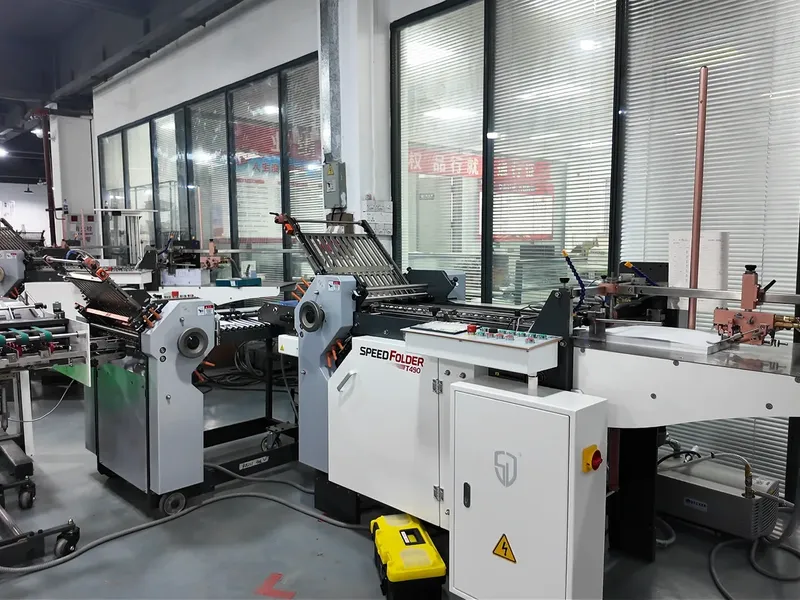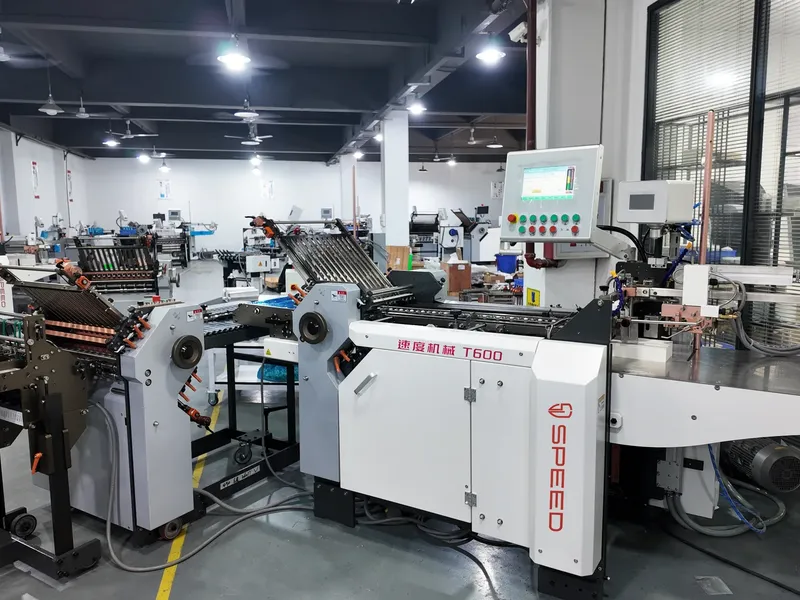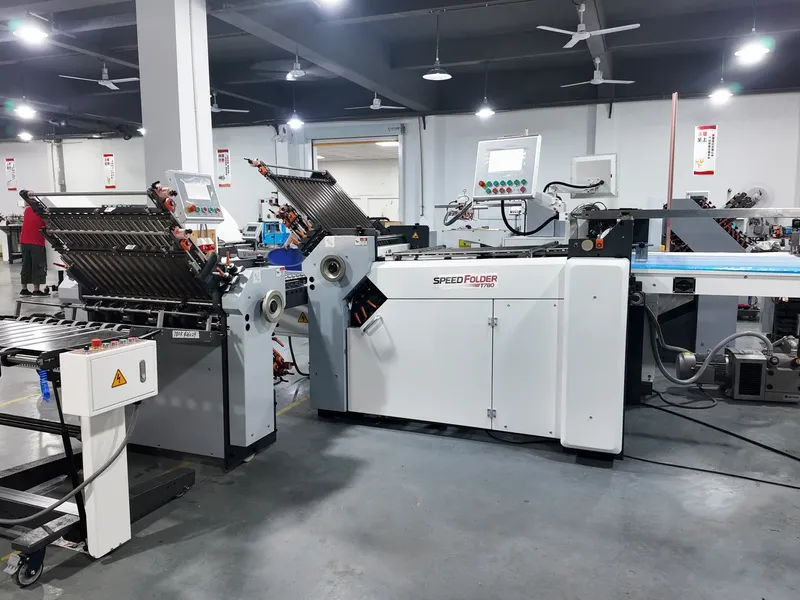
A folding machine is a straight-line process with four stages: separate, transport, fold, deliver. Understanding what happens in each stage is the fastest way to diagnose a folding problem, because the symptom almost always points at the stage that produced it — double sheets come from the feeder, drifting fold positions come from the rollers or the plates, and unsquared stacks come from the delivery.
1 · Separating the sheet from the pile
The feeder has to lift exactly one sheet from a pile of hundreds and hand it to the transport system without marking it. Two mechanisms are used on SPEED machines: suction wheels and vacuum (air) feeding, both working with a blower that creates the pressure difference.
Suction wheels are rotating wheels with small holes connected to a vacuum. As the wheel turns against the front of the pile, it grips the top sheet, pulls it forward and releases it into the transport rollers. The three-hole suction wheel used on the SPEED feeder is a compromise between grip and marking: more holes hold a difficult stock better, fewer holes mark a sensitive one less.
- Double-sheet detection compares sheet thickness as the paper passes and stops the machine if two sheets travel together — the single most valuable sensor on a pharmaceutical folder.
- Anti-static and anti-scratch handling matters on coated stock, where sheets cling to each other and marking shows on the print.
- Pile height decides how often the machine stops: 550 mm on the T490/T520/T600 platform, 750 mm on the T780.
2 · Transporting the sheet in register
Between the feeder and the fold, the sheet runs over a conveying system that has one job: keep the leading edge square to the folding rollers. Any skew introduced here becomes a fold-position error at the far edge, which is why the effect is far more visible on a 1200 mm wide sheet than on a 300 mm one.
Transport is also where the machine's speed is actually realised. The high-speed conveying system used across the SPEED range is specified for 220 m/min continuous transport with skew-free handling across a 35–250 gsm band, which is what allows the folding section to run at its rated 180 or 210 m/min without the sheet arriving late or crooked.
3 · Forming the fold
This is the part people mean when they ask how a folding machine works, and there are two mechanisms.
Buckle (plate) folding. The sheet is driven against an adjustable stop called a buckle plate. The leading edge stops, the paper behind it keeps moving, and the sheet bows — buckles — in the gap between two rotating rollers. The rollers grip the buckle and pull it through, and the fold is set at the point of the buckle. Because the plate is a movable stop, the fold position is set by moving the plate, and a machine with several plates can make several folds in sequence without any tooling change.
Knife folding. A blunt blade descends and pushes the sheet between two rollers. The fold position is fixed by the blade geometry, so the fold is extremely accurate and repeatable, but each knife makes one fold — multi-panel patterns are built from several units, or from a buckle unit plus a knife unit on a combination machine.
Note · This is why combination machines exist: buckle folds and knife folds in one pass, without moving the job to a second machine.
4 · Rollers, grip and creasing pressure
The folding rollers decide whether the fold is clean or cracked. SPEED machines use a combination of spiral-pattern and soft polyurethane rollers: the spiral pattern increases the area gripping the paper by roughly 75% compared with a straight pattern, which gives anti-slip and wear-resistant grip, while the polyurethane provides a compliant nip that does not crush the sheet.
Roller diameter sets how gently the sheet is bent. Small rollers (32 mm on the T490/T520/T600 platform) turn a tighter radius and suit thin, small-format work; larger rollers (40 mm on the T780) spread the same force over a wider nip, which is what keeps heavy and wide sheets from marking or cracking.
Creasing pressure is adjustable across the paper range — 35–250 gsm on the folding section — and the setting is stock-dependent, which is exactly the parameter established during a fold test on the customer's own paper.
5 · Driving the rollers: belt versus gear
Rollers can be driven by belts or by gears, and the difference only shows up under load. A belt drive can lose a small amount of speed when the paper resists, and because two rollers must stay synchronised, that loss shows up as fold-position variation. A fully sealed gear transmission delivers higher torque with no slip, holds roller speed constant, and runs inside a circulating-lubrication box that reduces wear and noise and is maintenance-free.
6 · Delivering a stack you can use
The last stage decides whether the work is actually finished. Folded pieces arrive at the delivery at speed and must be squared, counted and stacked without fanning out or falling over. Dual automatic stack-height control keeps the delivery at the right height as the stack grows, and a vertical stacker is used where folded panels are small enough to scatter — miniature pharmaceutical leaflets being the classic case.
Frequently asked
Why does the machine sometimes feed two sheets at once?
Why is my fold position drifting during a run?
What is the difference between a buckle plate and a knife?
Related footage
Booklet & brochure buckle folder in production
A T600-class buckle folder running multi-panel booklet and brochure folds — plate changeover, roller grip and stacker delivery shown end to end.
Watch on YouTube →Automatic industrial booklet folding at speed
High-speed booklet folding on an automatic feeder — servo feeding, double-sheet detection and continuous delivery under load.
Watch on YouTube →