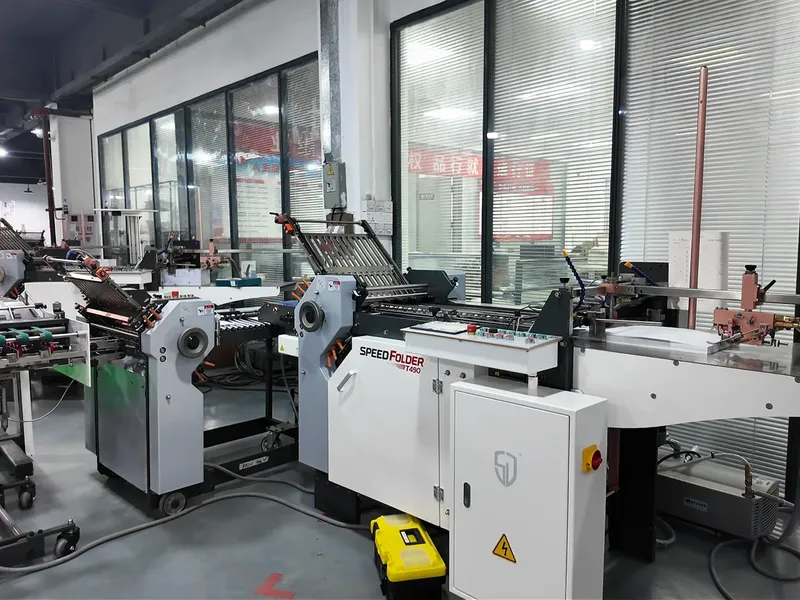
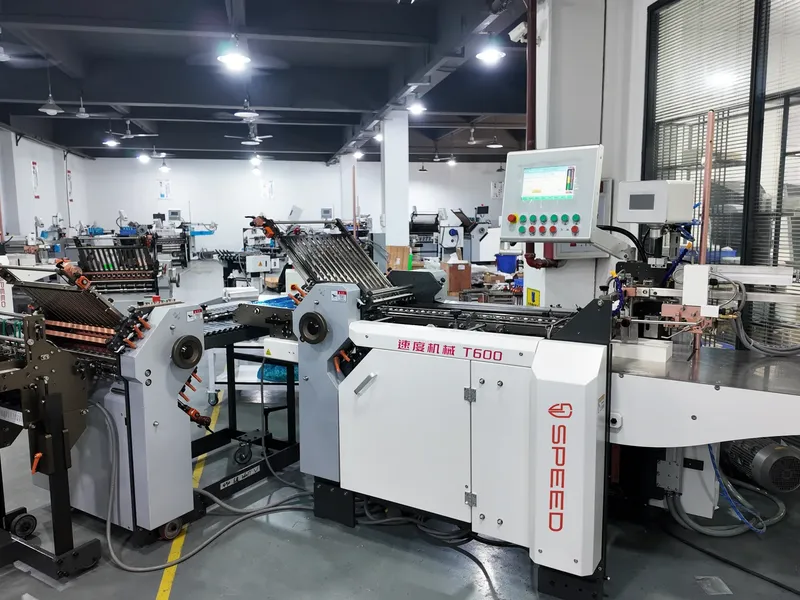
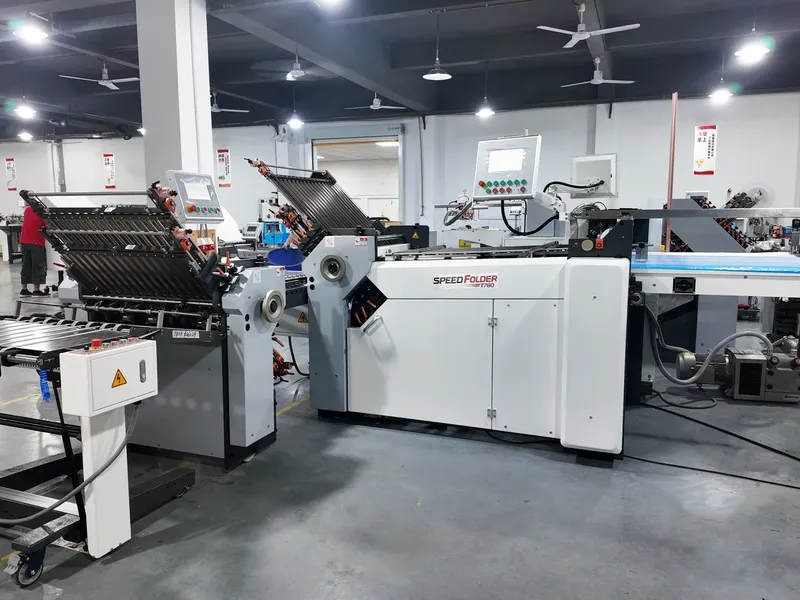
A paper folding machine is a print-finishing machine that turns flat sheets into folded products, including leaflets, brochures, instruction sheets and packaging inserts. It feeds and positions the paper, forms the required folds and delivers the finished work for the next production operation.
For a printer or packaging team, the important result is a repeatable finished format. The required dimensions, panel sequence and permissible variation depend on the job and the equipment that receives it. Folding does not necessarily require a separate crease to be made first.
What a folding machine actually does
A folding line has a feeder, a registration system, one or more folding stations and a delivery. The feeder separates sheets; registration controls their orientation; the folding stations create the panel sequence. Delivery may collect, count or stack the work, depending on the equipment specified.
Fold count and panel count are different. A letter-fold leaflet usually has two folds and three panels. An accordion fold uses alternating fold directions. A cross fold changes the folding direction and therefore needs a suitable second station or other handling arrangement. The finished drawing, rather than the number of panels alone, defines the machine configuration.
The three machine types
- Buckle folder: an adjustable stop in a buckle plate limits sheet travel so the paper bows into a folding roller pair. Plate settings, active plates and deflectors determine the parallel-fold sequence. Cross folds need an appropriately arranged additional station.
- Knife folder: a folding blade directs a registered sheet into a folding roller pair. Sheet positioning and stop settings determine the fold location; the blade is not a trimming tool.
- Combination folder: buckle and knife folding stations are arranged on one machine. This is a general machine architecture; availability and the actual station arrangement must be checked for the proposed model.
Folding knives and cutting knives perform different operations. If a job also needs trimming, perforating or gluing, specify those operations separately.
What a folding machine is not
- Creasing prepares a line in the stock before folding. It can be helpful on some coated or heavier papers, but it does not expand the approved paper range of a folder.
- Cutting and trimming remove material. Some lines have separate cutting equipment or slitter shafts; the presence of a folding knife does not establish a cutting capability.
- Stitching, gluing and pressing have their own purposes. A line may integrate these processes, but they are not included simply because it folds paper.
Where the boundaries of the machine are
Check both the flat sheet entering the machine and the folded product leaving it. Minimum feed size, maximum feed size, minimum fold length, paper specification and finished thickness are separate limits.
- Feed size: the supplied reference table lists 60 × 100 mm minimum and 490 × 1000 mm maximum for the T490. The T780 is listed at 150 × 150 mm minimum and 780 × 1200 mm maximum.
- Paper specification: confirm the model-specific weight range, coating, grain direction and condition of the stock. Paper weight alone cannot establish whether a particular job will run.
- Fold length and arrangement: the reference minimum buckle fold is 20 mm for the T490/T520/T600 and 45 mm for the T780. This is not the minimum finished product size for every pattern.
- Pile and speed: listed feed pile heights are 550 mm for the T490/T520 and 750 mm for the T600/T780. Listed linear speeds are 180 m/min for the T490/T520/T600 and 210 m/min for the T780; they are not guaranteed finished-piece rates.
These are reference specifications from the supplied model table. The confirmed configuration and order specification govern the machine supplied.
How to tell whether you need one
Start with the jobs you currently fold or outsource: sheet and finished sizes, paper, pattern, quantities and customer tolerances. Record the time spent setting up, folding, handling and inspecting them. Compare that workload with an actual machine trial and the proposed staffing arrangement.
For occasional simple jobs, manual folding or an outside finisher may be sufficient. For repeat production, evaluate setup time, acceptable output, waste and downstream handling together. There is no universal monthly quantity at which a folder pays for itself.
Frequently asked
Is a paper folding machine the same as a paper creasing machine?
They perform different operations. Creasing prepares a line in the stock; folding bends the sheet into the required panels. A folding line may include creasing, but many leaflet jobs are folded without a separate pre-crease.
Can a folding machine fold card and cover stock?
Check the specific machine, stock and fold pattern. Coating, grain direction and folded thickness matter as well as gsm. A sample trial may show that creasing is useful, but neither creasing nor a knife station permits operation outside the approved machine limits.
How many folds can one machine make?
It depends on the active plates or knives, station arrangement and the job. A single trip through a machine can contain several successive folds. Specify the finished panel drawing and fold sequence rather than relying on a plate count alone.
Related footage
Pharmaceutical leaflet folding in miniature format
Patient information leaflets folded from 60 × 100 mm sheets — the accuracy regime that decides whether a leaflet feeds on a cartoning line.
Watch on YouTube →Multi-panel accordion and cross folds
A run through the standard multi-panel fold patterns: accordion, letter, gate and cross folds on one machine.
Watch on YouTube →