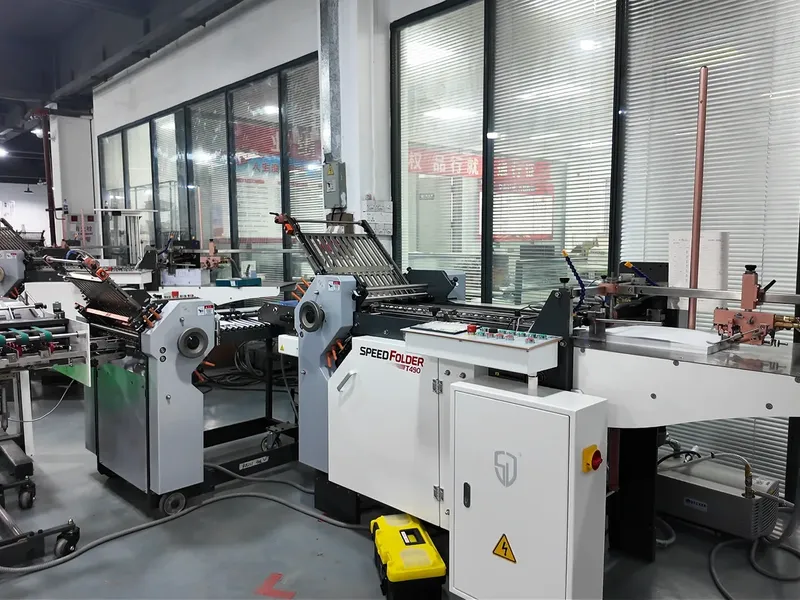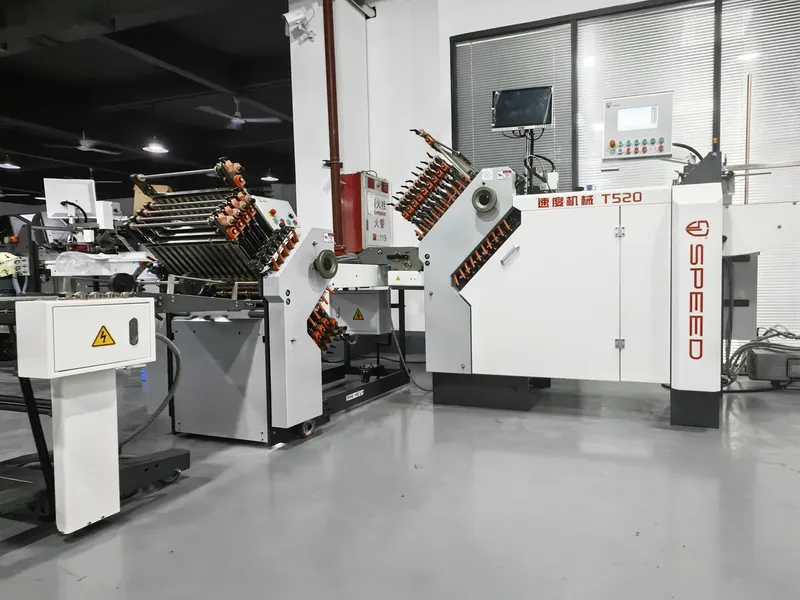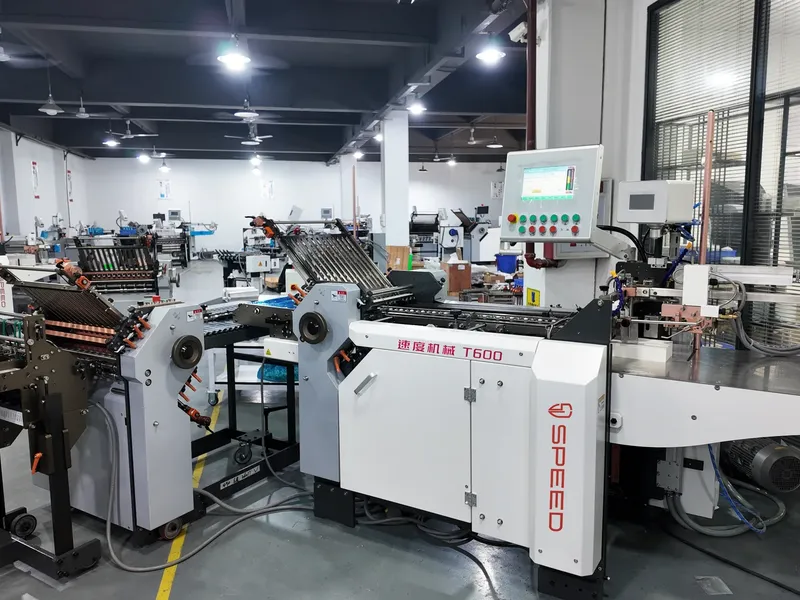
Two folding machines can look identical in a brochure and differ by a factor of two in price. The difference is almost never the frame — it is the feed system, the transmission, the number of plates and the control package. This guide sets out what each element contributes, so that the quotation you receive can be read line by line rather than compared on the total.
What drives the price
- Platform size and rigidity — a 780 × 1200 mm machine is a heavier structure with larger rollers and a bigger drive than a 490 × 1000 mm machine.
- Feeder type — a standard suction-wheel automatic feeder costs less than a vacuum or recirculating feeding system, and the difference is justified by run length, not by brochure appeal.
- Plate count and configuration — more buckle plates means more folding units and more labour, so a 14+6 machine is materially more expensive than a 4-plate machine.
- Transmission — gear transmission inside a sealed circulating-lubrication box costs more than belt drive, and buys slip-free roller speed and lower maintenance.
- Control and instrumentation — PLC touch-screen control, automatic stack-height control, double-sheet detection and CCD inspection are separate line items.
- Inline modules — a parallel knife unit (SD-X250) or a pressing machine (SD-XP300) is a second machine, priced as one.
Options that usually earn their cost
- Double-sheet detection — on pharmaceutical or any counted work, it is the cheapest insurance against a mixed batch.
- Automatic stack-height control — removes an operator from the delivery and keeps the stack square.
- A recirculating or round-pile feeder — pays back whenever the folder would otherwise stop for reloads several times a shift.
- Gear transmission with sealed lubrication — pays back over the asset life in roller-speed stability and reduced maintenance.
- A vertical stacker — necessary, not optional, for miniature panels that would otherwise fan out at the delivery.
Options that are often oversold
- Maximum rated speed — nobody runs a folder at its ceiling all week; the usable speed on your stock is the number that matters.
- Plate counts beyond your pattern list — unused plates are capital sitting still.
- A larger platform "for the future" — if the future arrives, the small-format work will still be better served by a small-format machine.
Installation requirements to plan for
Folding machines are installed once and then run for years, so the site questions are worth answering before the order, not after the crate arrives.
- Floor: the T780 needs 4300 × 1700 × 3500 mm of space and weighs 1560 kg; the T600 platform is 4650 × 1200 × 1500 mm and 1200 kg. Check floor loading and door access.
- Power: 380 V for the buckle platforms (3.5 kW on the T490/T600, 5 kW on the T780); the SD-X250 knife unit runs 220 V at 0.9 kW.
- Air: the SD-X250 requires a 0.4–0.6 MPa air supply.
- Environment: stable temperature and humidity matter for paper handling and static, especially on coated stock.
- Access for service: leave room to open panels and to remove rollers.
Lead time, spares and support
Ask three questions of any supplier: what the production lead time is, what the recommended spare-parts kit contains (suction wheels, belts where used, folding rollers, and the consumables specific to your configuration), and what response time is committed for technical support. For a machine that sits in the middle of a production line, the support answer is as important as the price.
SPEED machines are built in Dongguan, Guangdong, with a standard production lead time in the region of 15–20 days and 15–20 day shipping preparation; confirm the current figure for your configuration and destination at the time of order.
Acceptance testing
The asset is only proven when it produces your product within your tolerance. Define acceptance before delivery: the paper, the pattern, the running speed, the sample size and the measurement method.
- Fold position: measure the panels on the first, middle and last pieces of a run, not just on a hand-picked sample.
- Consistency: check that the count at the delivery matches the count fed.
- Throughput: run at the intended production speed for a continuous period and record output and stoppages.
- Documentation: confirm the CE and ISO documentation and the manuals you need for your qualification process.
Note · Where a customer cannot travel, we run the acceptance test in our fold-test room and ship the folded samples with measurements for approval.
Frequently asked
How much does a paper folding machine cost?
What is the lead time?
What spare parts should be kept on site?
Does the machine come with training?
Related footage
Pharmaceutical leaflet and insert folding line
The pharmaceutical folding line as a system: miniature buckle folding, parallel knife trimming and press flattening working as one process.
Watch on YouTube →Commercial A4 folding for leaflets and inserts
Everyday commercial print finishing: A4 leaflets, brochures and inserts folded on a single automatic folder.
Watch on YouTube →