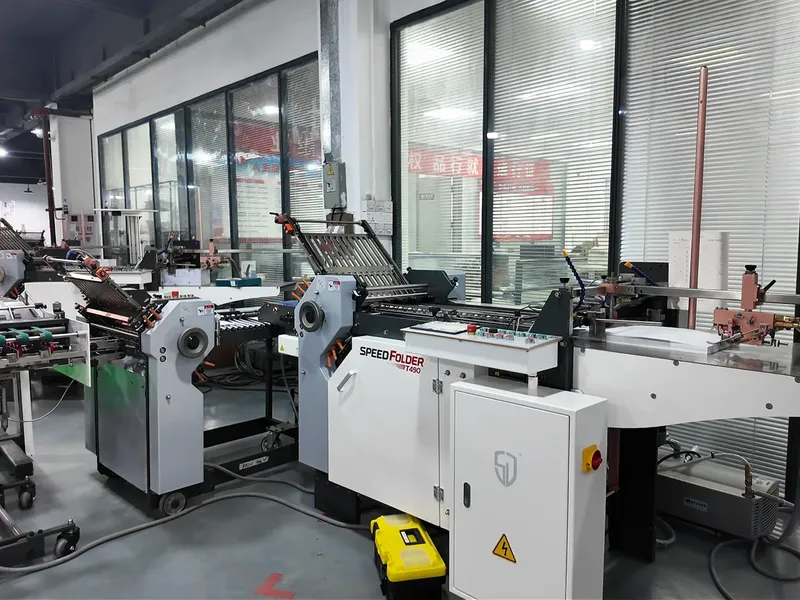
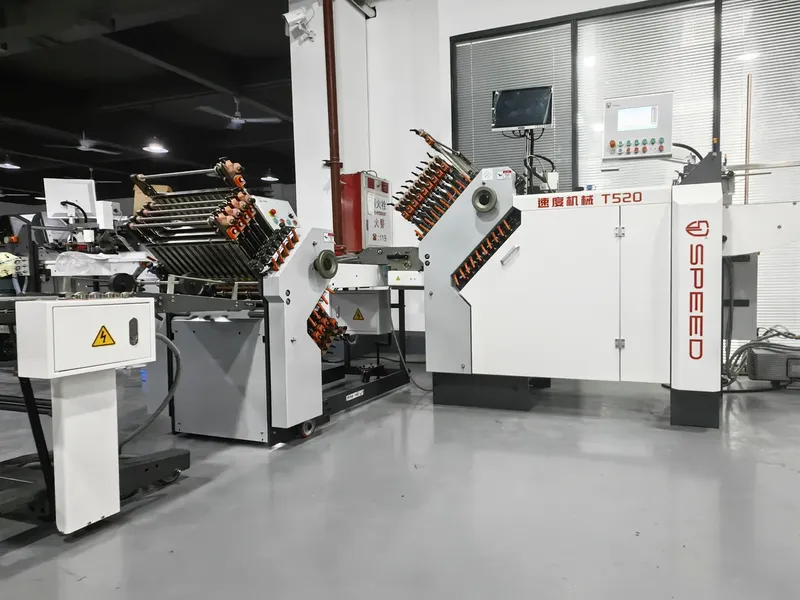
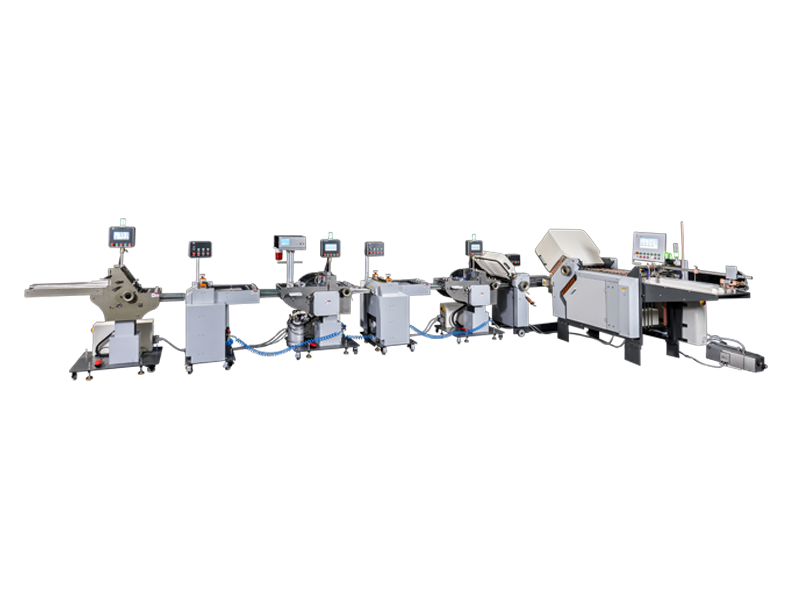
A buckle folding machine creates a fold by pushing paper against a stop so it buckles, then pulling the buckle through rollers. A knife folding machine creates a fold by pushing a blade down onto the sheet and forcing it between rollers.
That one difference in how the fold is made decides almost everything else: which fold types each method can produce, which paper it handles best, how fast it runs, and which jobs it is right for.
If you are choosing your first automatic paper folding machine, this guide compares the two methods side by side, so you can match the folding method to your products instead of buying speed you do not need. Where this guide gives a model specification, it gives the verified reference specification for that named model — not a generic class range.
What Is a Buckle Folding Machine?
How Buckle Folding Works
In buckle folding, the sheet is driven forward by rollers until its leading edge hits an adjustable stop inside a folding plate, also called a buckle plate. The sheet cannot go further, so it buckles slightly upward. A pair of folding rollers catches that buckle and pulls it through, pressing a sharp crease into the paper.
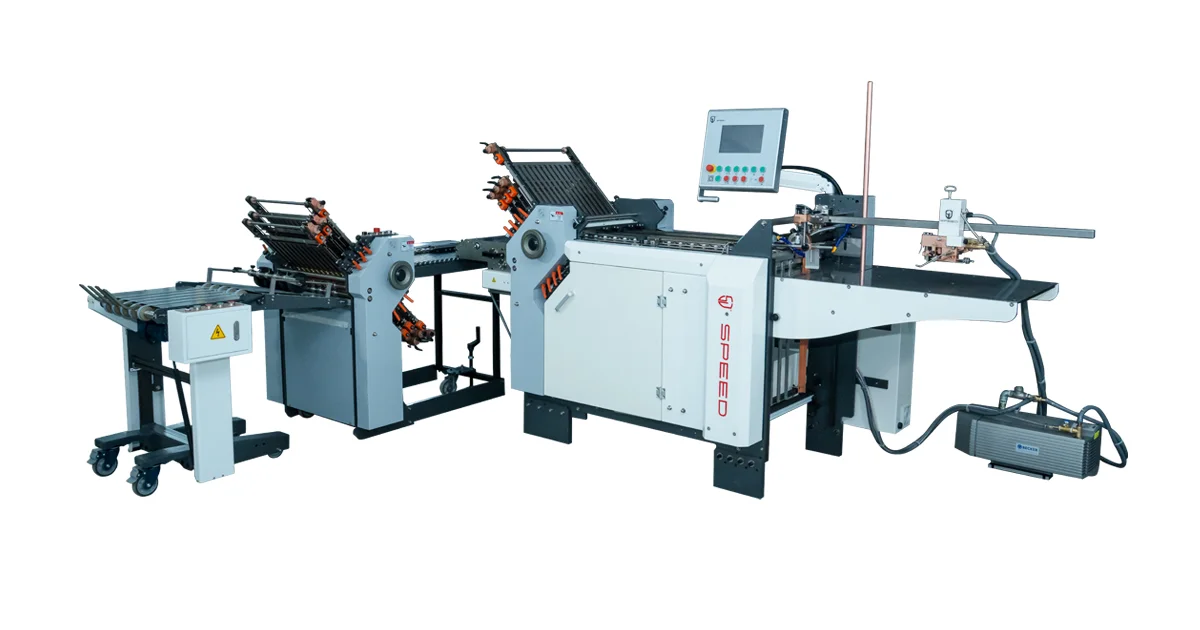
By arranging several folding plates in sequence, one machine can create two, three, four, or more parallel folds in a single pass — for example a letter fold, an accordion fold, or a double parallel fold. The number of plates and the fold sequence depend on the model and the fold pattern you need, so confirm the configuration for your fold types before you order, rather than assuming every buckle machine has the same plate count.
Strengths of Buckle Folding
Buckle folding is the most flexible folding method. It handles the widest range of parallel fold types, changes over quickly between jobs, and works well for the thin paper used in pharmaceutical leaflets. That thin paper sits at the light end of the verified buckle range — 35–200 gsm for the T490, T520 and T600 series — provided the feeder separates thin sheets cleanly and static is controlled.
It is also the most common method for leaflets, brochures, instruction manuals, and packaging inserts, where the same machine must handle many different jobs in small to medium batches. For those jobs, fast changeover matters as much as top speed, because a machine that spends its day being reset is not producing folded sheets.
Limits of Buckle Folding
Buckle folding is less efficient for folding a large sheet in half at a right angle to the first fold — a cross fold. It can do it, but only with a knife unit added after the buckle section, and the setup is more complex. Very thick or stiff paper can also resist buckling cleanly, which can cause skewing or cracking on the fold line. That is why the top of the paper range matters: the buckle series in this guide are rated to 200 gsm, or 210 gsm for the T780, and paper above that range needs a different check — a sample test with your own paper, not a brochure claim.
What Is a Knife Folding Machine?
How Knife Folding Works
In knife folding, the sheet is positioned over a gap between two rollers. A thin folding knife, or blade, pushes the centre of the sheet down through that gap. The rollers catch the folded sheet and press the crease.
Unlike buckle folding, the fold is made by the knife, not by the paper buckling against a stop. That makes knife folding very precise for a single fold in a specific place, especially a fold at 90 degrees to the previous fold. The knife forces the fold, so it does not depend on the paper buckling on its own.
Strengths of Knife Folding
Knife folding is the standard method for cross folds and for folding large sheets in half. It is the method used for 8-page, 12-page, and 16-page signatures in book printing, where a large printed sheet must be folded several times in two directions.
It also handles heavier paper and larger formats more reliably than buckle folding alone, because the knife forces the fold instead of relying on the paper to buckle. On the combination model in this guide, the K780-F, the smallest knife fold is 100 × 65 mm, and the machine takes sheets up to 780 × 1200 mm — the large-format end of the range where knife folding earns its place.
Limits of Knife Folding
A knife unit on its own is not a flexible all-round folder. It is best at one fold at a time, usually a cross fold or a half fold, and it is slower and less economical for producing many different parallel folds in one pass. Buying a machine that only does knife folding would leave most brochure and leaflet work uncovered.
That is why, in practice, buyers rarely choose between a "buckle machine" and a "knife machine" as two separate machines. They choose a buckle machine, or a combination machine that has both. Knife folding, in the SPEED range, is a folding unit inside a combination machine — and an optional independent knife on the buckle series — not a standalone machine type on its own.
Buckle vs Knife Folding at a Glance
Knife Folding | ||
|---|---|---|
How the fold is made | Paper buckles against a stop, rollers pull the buckle through | A blade pushes the sheet between rollers |
Best fold types | Single, letter, accordion, double parallel, gate, roll | Cross fold, half fold, book signatures |
Best paper | Thin to medium paper within the model's rated range; pharma leaflets at the light end | Medium to heavy paper, large-format sheets |
Fold accuracy | Good on parallel folds when rollers, guides and plate stops are set correctly; ask for a tolerance on your paper and fold, as no single accuracy figure covers every model | Good on cross folds for the same reason — setup and condition matter more than the method name |
Speed | Rated by model: 180 m/min for the T490 / T520 / T600 buckle series, 210 m/min for the T780 | High for single cross folds, lower for multi-fold sequences that need more stations |
Changeover | Fast, especially with motorised plates and job memory | Moderate, knife position must be set precisely |
Best for | Leaflets, brochures, manuals, pharma inserts | Books, catalogues, magazines, 16-page inserts |
Read the speed row carefully. A rated speed is a maximum for the machine under its rated conditions, not the speed you will hold all day on every job. Real sustained speed falls with complex cross folds, large sheets, and heavy paper. Compare machines by sustained speed with your paper and your fold type, not by maximum speed alone.
Which Fold Types Can Each Method Produce?
Buckle Folding Can Produce
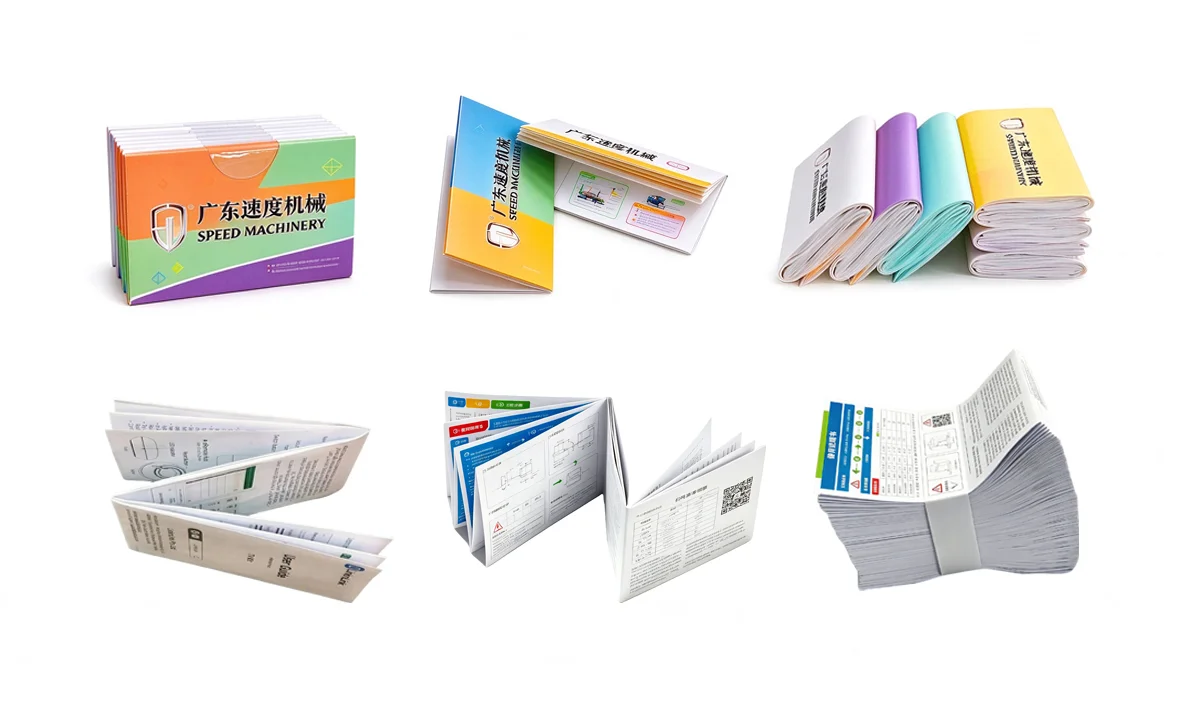
- Single fold, double parallel fold, letter fold (C-fold), accordion / Z-fold, gate fold, and roll fold — all parallel folds made in one pass through several plates.
- Short cross folds when a knife unit is added after the buckle section.
Knife Folding Can Produce
- Cross folds at 90 degrees to the first fold, half folds on large sheets, and multi-page signatures (8, 12, and 16 pages).
- It is not the efficient way to make a letter fold or an accordion fold on its own.
The Practical Rule
If your product needs several parallel folds, start with buckle folding. If your product needs a fold in a second direction, you need a knife unit — either as part of a combination machine, or as a second folding station after the buckle section. That rule, applied to your real top five fold types, will narrow the choice faster than any specification table.
Paper, Speed and Sheet Size Compared — SPEED Models
This section is where the verified specifications belong. All values below are reference specifications from the SPEED tables supplied on 2026-11-10, for the named models. Final specifications are subject to the confirmed customized order.
Buckle Models: T490, T520, T600 and T780
Model | Paper weight | Rated speed | Max sheet | Min sheet | Min fold width | Folding roller |
|---|---|---|---|---|---|---|
35–200 gsm | 180 m/min | 490 × 1000 mm | 60 × 100 mm | 20 mm | 32 mm | |
35–200 gsm | 180 m/min | 520 × 1000 mm | 60 × 100 mm | 20 mm | 32 mm | |
35–200 gsm | 180 m/min | 600 × 1000 mm | 60 × 100 mm | 20 mm | 32 mm | |
40–210 gsm | 210 m/min | 780 × 1200 mm | 150 × 150 mm | 45 mm | 40 mm |
Three things in that table decide most buying choices. First, the T490, T520 and T600 share the same paper range and speed; what changes between them is the maximum sheet size. Choose by the largest sheet you actually print, not by the smallest model that looks cheaper. Second, the T780 is the step up: a wider paper range to 210 gsm, a higher rated speed of 210 m/min, and a maximum sheet of 780 × 1200 mm, with a larger 40 mm folding roller and a minimum sheet of 150 × 150 mm. Third, the minimum sheet matters as much as the maximum. If you fold small pharmaceutical leaflets, check the minimum sheet first — the T490 to T600 series and the T520 Pharma model go down to 60 × 100 mm, while the T780 starts at 150 × 150 mm.
Pharmaceutical Inserts: T520 Pharma Packaging Series
Pharmaceutical work deserves its own row, because the paper is thin, the folds are many, and a bad sheet cannot simply be reprinted and slipped into a medicine pack. The T520 Pharma Packaging Series is rated at 35–200 gsm and 180 m/min, with a maximum sheet of 520 × 1000 mm. Its minimum sheet is 60 × 100 mm as standard, and 100 × 120 mm with waste rejection. That waste-rejection minimum is the number to check if you plan to reject faulty sheets automatically: the smallest sheet you can reject is larger than the smallest sheet you can fold.
For pharmaceutical inserts, do not choose on speed alone. Check the minimum sheet, the minimum fold width — 20 mm on this model — and how the feeder handles thin paper at the light end of the range. Then test with your own leaflet paper, folded to your own finished size.
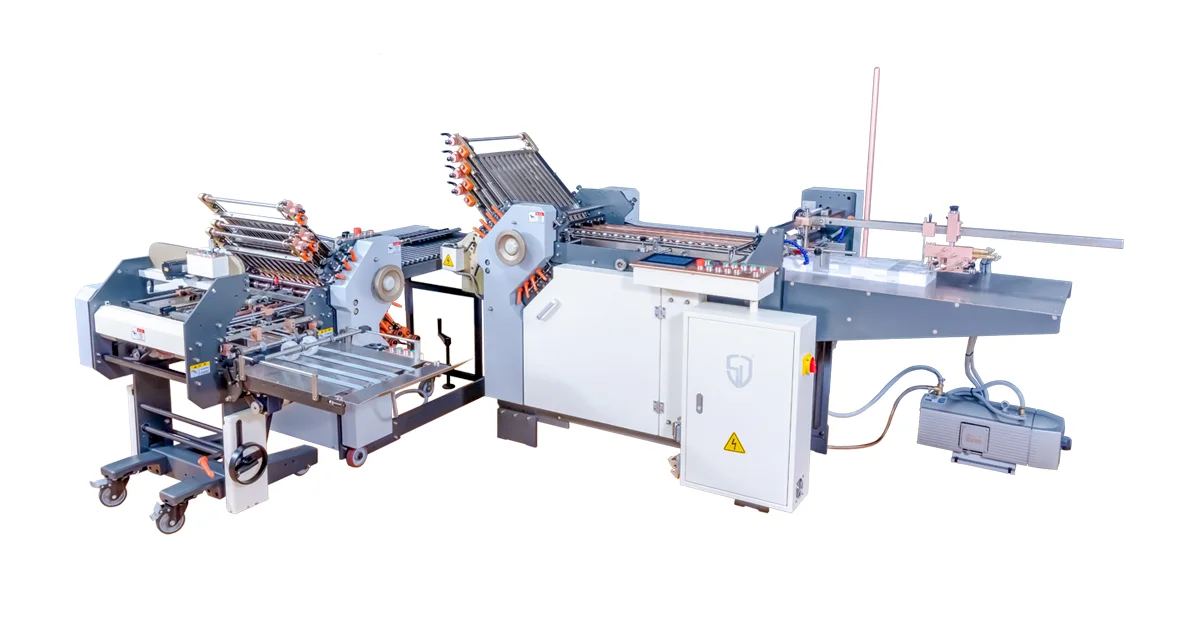
Combination Model: K780-F Combination Folding Machine
The K780-F is the combination machine in this range: buckle units for parallel folds, plus a knife unit for cross folds. Its verified reference specifications are 28–200 gsm, a maximum operating speed of 210 m/min, a maximum sheet of 780 × 1200 mm, a minimum sheet of 150 × 150 mm, and a minimum knife fold of 100 × 65 mm. It is rated at 6.5 kW on 380 V, measures 4800 × 1700 × 1950 mm, and weighs 2500 kg.
Note the paper range starts lower than the buckle-only models, at 28 gsm, and the maximum sheet matches the T780. That combination — wide sheet, thin-to-medium paper, and a knife unit — is what makes it the usual choice when one machine must cover both leaflets and book signatures. It is also the model to ask about in the Day 2 article on combination folding machines, where its configuration is covered in full.
What This Guide Does Not Claim
Two things are deliberately not given as specifications here. Folding accuracy in millimetres does not appear in any of the supplied SPEED tables, so no accuracy figure is quoted for any model in this article. If a buyer needs a tolerance, the right step is a sample folding test with their own paper and fold, and a written tolerance from the supplier for that job — not a generic figure copied from another machine class. The same applies to buckle-plate counts: the number of plates depends on the model and the fold configuration, so confirm it for your fold types instead of relying on a single number in a guide.
Which Is Right for You? Decide by Product
Your main product | Choose | Why |
|---|---|---|
Pharmaceutical leaflets and inserts | Buckle folding machine | Thin paper, many parallel folds, fast changeover; check the T520 Pharma minimum sheet and waste-rejection size |
Brochures, flyers, and leaflets | Buckle folding machine | Flexible fold types, many short jobs |
Instruction manuals | Buckle folding machine, knife unit if cross-folded | Parallel folds first, cross fold for multi-page manuals |
Booklets, catalogues, and magazines | Combination folding machine (buckle + knife) | Needs both parallel and cross folds |
Book signatures, 8–16 pages | Combination folding machine | Knife folding is essential for cross folds; K780-F minimum knife fold is 100 × 65 mm |
Large-format commercial print | Combination folding machine | Knife folding handles large sheets in half more reliably; check the 780 × 1200 mm maximum sheet |
Ask These 5 Questions Before You Decide
- What is your finished folded size, and how many pages does the product have?
- Which fold types do you need most — parallel folds, cross folds, or both?
- What paper do you run most — thin pharma paper, coated paper, or paper near the top of the rated range?
- How many sheets per job, and how many different jobs per week?
- Will one machine need to cover both leaflets and book work, or only one of them?
If the answer to question 5 is "both", a combination machine is almost always the better investment than a buckle-only machine. If the answer is "leaflets only", a buckle machine in the right sheet size — T490, T520 or T600 for sheets up to 600 × 1000 mm, T780 for sheets up to 780 × 1200 mm — is usually enough.
Why Combination Folding Machines Exist
A combination folding machine, also called a buckle-knife combination folder, puts buckle folding units and knife folding units in one machine. The buckle section makes the parallel folds. The knife section makes the cross fold.
That combination covers the gap neither method covers alone. It is the standard choice for book printing, catalogues, and large-format commercial print, and for any print shop that folds both leaflets and multi-page signatures.
The K780-F in this guide is built on that principle: buckle plates for flexible parallel folding, plus a knife unit for cross folding, so one machine can handle a wider range of jobs without a second folding line. Its rated paper range of 28–200 gsm and its maximum operating speed of 210 m/min are the reference figures to compare — but the decision is still the fold list. If your work never needs a cross fold, you are paying for a knife unit you will not use.
How to Choose: A Simple Decision Process
Step 1: List your top 5 fold types. Write them down from real jobs, not from a brochure. This list decides the folding configuration.
Step 2: Check your paper against the rated range. Note the lightest and heaviest paper you run, and whether it is coated. Thin paper favours buckle folding with a good feeder. Paper near the top of a model's range — 200 gsm on the T490 to T600 series, 210 gsm on the T780 — needs a sample test, because the top of the range is where buckling, cracking and skew show up first.
Step 3: Check your sheet size against the maximum and the minimum. A machine that takes your largest sheet but cannot take your smallest leaflet is the wrong machine. Check both ends: for example, 60 × 100 mm minimum on the T490 to T600 series, 150 × 150 mm minimum on the T780 and the K780-F.
Step 4: Count your volume and variety. Many short jobs favour fast changeover and job memory. Long runs of one product favour sustained speed and feeding stability — the case for a recirculating feeder machine, covered in the buying guide for mass production.
Step 5: Test with your own paper. Send your paper and artwork for a sample folding test. Ask the supplier to show the folded samples, the speed, and the waste rate for your fold type. A test with your paper is worth more than a specification sheet.
Step 6: Compare total cost, not machine price. Include setup time, waste, labour, and changeover. A machine that changes over in 5 minutes instead of 20 minutes can be worth more than a machine that runs 10% faster — but do not take either number from a guide. Ask for the changeover time on your jobs.
Conclusion
Buckle folding and knife folding are not rivals. They are two tools for two different jobs: buckle folding for flexible parallel folds, knife folding for precise cross folds.
Choose by product, not by brochure speed. List your fold types, check your paper against the rated range, check your sheet size at both ends, and test with your own samples. If your work needs both fold directions, a combination machine gives you both in one line — and saves you from buying a second machine later.
If you are looking for a buckle, combination, or recirculating feeder folding machine for your print shop, SPEED Machinery can help you test folding with your own paper samples. SPEED Machinery is a China-based manufacturer of high-speed automatic paper folding machines, with CE-certified products and ISO-certified management. Its team provides pre-sales selection consultation, sample folding tests, installation, training, and after-sales support.
Contact SPEED Machinery for a tailored recommendation and quotation — share your paper specifications, finished folded size, and target output, and they will suggest the most suitable model for your production.
Frequently asked
What is the difference between buckle folding and knife folding?
Buckle folding creates a fold by pushing paper against a stop so it buckles, then pulling the buckle through rollers. Knife folding creates a fold by pushing a blade down onto the sheet and forcing it between rollers. Buckle folding is best for parallel folds; knife folding is best for cross folds.
Is a knife folding machine better than a buckle folding machine?
Neither is better in general. Buckle folding is better for leaflets, brochures, and pharmaceutical inserts with several parallel folds. Knife folding is better for cross folds and book signatures. Most buyers who need both choose a combination folding machine with buckle and knife units, such as the K780-F.
Can a buckle folding machine do a cross fold?
Yes, but only if it has a knife folding unit after the buckle section. A buckle-only machine is designed for parallel folds. For 8-page and 16-page cross-folded products, a combination machine is the usual choice.
Which folding machine is best for pharmaceutical inserts?
A buckle folding machine is usually best for pharmaceutical inserts, because they are printed on thin paper and need several accurate parallel folds, often with a cross fold. For the T520 Pharma model, check the minimum sheet — 60 × 100 mm standard, 100 × 120 mm with waste rejection — and the 35–200 gsm paper range and 180 m/min rated speed against your own leaflet. A machine with a recirculating feeder is preferred for long runs, because it feeds thin paper more reliably at high speed.
Do I need a combination folding machine?
You need one if your work regularly includes both parallel folds and cross folds — for example, if you fold both brochures and book signatures. If you only fold leaflets and brochures, a buckle folding machine is usually enough and costs less. Check the K780-F figures — 28–200 gsm, 210 m/min maximum operating speed, 780 × 1200 mm maximum sheet, 100 × 65 mm minimum knife fold — against your largest sheet and your heaviest paper before you decide.