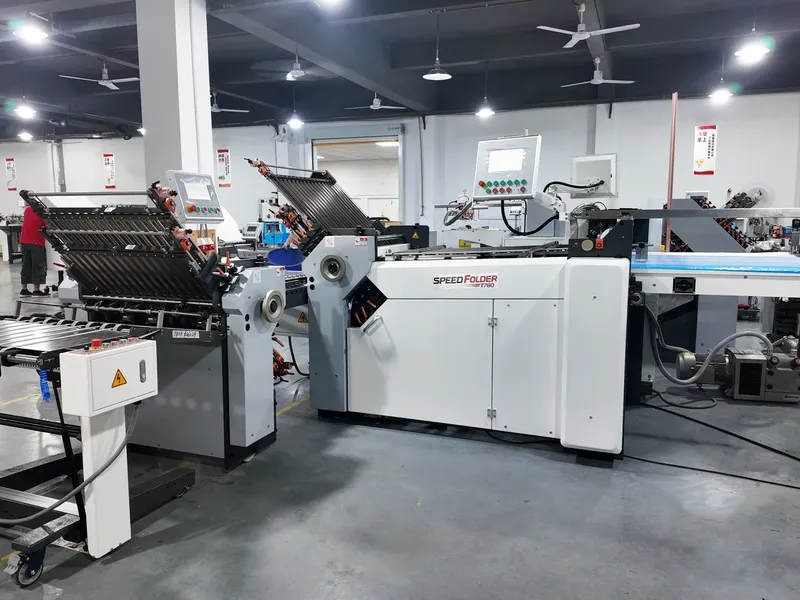
Industrial paper folding machines support print finishing, pharmaceutical leaflets and packaging inserts. The SPEED T490, T520 and T600 series accept sheets from 60×100 mm and are rated for speeds up to 180 m/min; the T780 accepts 150×150 mm to 780×1200 mm sheets and is rated up to 210 m/min. Published paper weight ranges are 35–200 gsm for the T490/T520/T600 and 40–210 gsm for the T780. Select the machine and inline modules around the actual stock, fold sequence and finished-piece requirements, then confirm performance with a sample fold test.
Machine Types & Capabilities
Buckle Folding Systems
Our buckle folding machine range includes four series with different sheet capacities:
Model | Max Sheet Size | Paper Weight | Min Buckle Fold | Pile Height |
|---|---|---|---|---|
780×1200 mm | 40–210 gsm | 45 mm | 750 mm | |
600×1000 mm | 35–200 gsm | 20 mm | 750 mm | |
520×1000 mm | 35–200 gsm | 20 mm | 550 mm | |
490×1000 mm | 35–200 gsm | 20 mm | 550 mm |
These series use 32–40 mm diameter folding rollers. The T490, T520 and T600 accept minimum sheets of 60×100 mm; the T780 requires at least 150×150 mm. Available fold patterns depend on the number of buckle plates, folding stations and selected modules. Confirm fold registration, crease quality and usable output on the intended paper during a sample trial.
Knife & Pressing Equipment
Our Knife & Pressing Equipment line includes specialized modules for inline workflows:
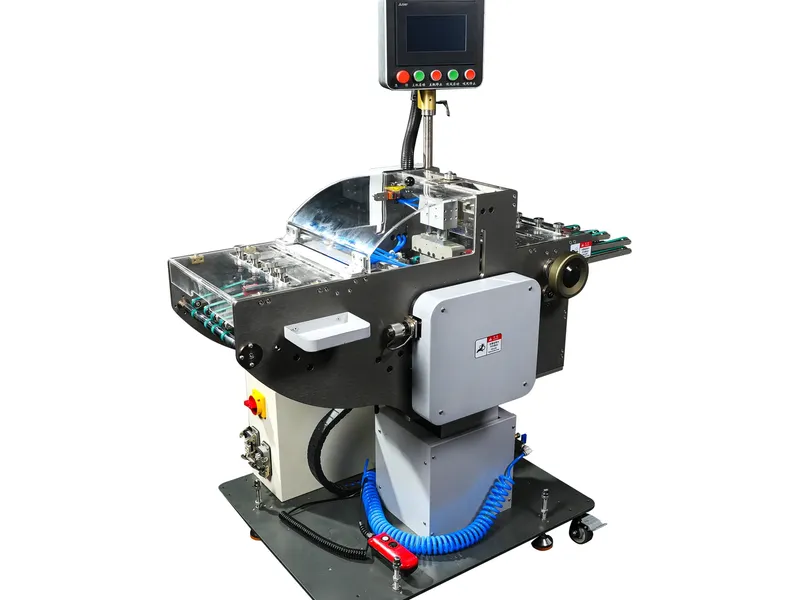
- SD-X250 Parallel Knife Unit: inline parallel knife unit handling sheets 30×60 mm to 160×260 mm, finished thickness up to 15 mm
- SD-XP300 Pressing Machine: pneumatic pressure drive with 300 mm working width, speeds 1–60 m/min, finished thickness 1–20 mm, consuming only 1 kW power
An inline knife unit can add a folding stage when the required fold sequence and finished-piece dimensions call for it. For pharmaceutical outsert production, confirm the unit, stock and downstream interfaces with a sample trial; a finished-piece thickness limit does not establish suitability for every paper weight.
Applications Across Industries
Publishing & Commercial Printing
For book signatures and brochures and catalogues, select sheet format, folding stations and delivery equipment around the job. Commercial printing output depends on stock, fold sequence, feeding and changeover time. In publishing, the T600 and T780 offer a published pile height of 750 mm. Measure finished pieces per hour on the proposed job rather than deriving output from transport speed alone.
Pharmaceutical & Packaging
The pharmaceutical sector needs legible text and consistent finished dimensions for leaflets and outserts. Choose pharmaceutical folding equipment around the supplied sheet, fold sequence and packaging-line interfaces. For packaging inserts, confirm paper weight and coating against the selected model; the T490/T520/T600 range is 35–200 gsm and the T780 range is 40–210 gsm. Acceptance tolerances should be agreed and checked using production samples.
In packaging production, assess folding equipment together with handling and downstream cartoning. Compare usable output, rejected pieces, changeover time and operator workload during the trial to establish the benefit for the actual production line.
Selection & Specification Criteria
Matching Machine to Application
When specifying an industrial paper folding machine, prioritize these parameters:
- Sheet size range: measure your smallest and largest substrates; the T780 accommodates up to 780×1200 mm, while compact operations may suffice with the T490's 490×1000 mm capacity
- Paper weight: compare the intended stock with the published range: 35–200 gsm for T490/T520/T600 and 40–210 gsm for T780. Confirm coated, lightweight or heavy stock through sample testing.
- Fold complexity: specify the required fold sequence and finished dimensions. Match buckle plates and folding stations to the job; add an SD-X250 knife unit only where the proposed configuration requires that stage.
- Production volume: pile heights of 550–750 mm affect loading intervals. Assess feeding continuity, changeovers and operator workload using the actual sheet size and stock.
Integration & Workflow
Review feeding equipment and the interfaces to upstream and downstream machines for the proposed line. The recirculating feeder folding machine uses pre-cut sheets and supports continuous reloading; it is not a web-fed system. Confirm compatible host models, sheet format and delivery layout before ordering.
Electrical and air requirements are model-specific. Published T490 and T600 specifications list 3.5 kW machine power and 380 V; the recirculating feeder configuration lists 5 kW and 380 V. The SD-XP300 pressing module lists 1 kW, 220 V and an air pressure range of 0.4–0.6 MPa. Confirm the supply requirements against the final ordered configuration before installation.
Frequently asked
What sheet sizes can industrial paper folding machines handle?
The T490, T520 and T600 accept sheets from 60×100 mm, with respective maximum sizes of 490×1000 mm, 520×1000 mm and 600×1000 mm. The T780 accepts 150×150 mm to 780×1200 mm sheets. Published minimum buckle fold sizes are 20 mm for the T490/T520/T600 and 45 mm for the T780. Confirm the finished fold and feeding limits for the selected configuration.
What paper weights work with buckle folding machines?
Published paper weight ranges are 35–200 gsm for the T490, T520 and T600, and 40–210 gsm for the T780. Stock coating, grain direction, fold sequence and finished dimensions also affect suitability. Confirm the proposed stock with a sample trial. The SD-X250 knife unit has a published finished-piece thickness limit of 15 mm; this is a different measure from paper grammage and does not guarantee suitability for every substrate.
How fast do industrial folding machines operate?
The T490, T520 and T600 are rated for speeds up to 180 m/min; the T780 is rated up to 210 m/min. These are machine speed ratings, not guaranteed finished pieces per hour. The separate SD-XP300 pressing module has a speed range of 1–60 m/min. Actual line output depends on the stock, fold sequence, feeding, inline modules, changeovers and rejection rate, and should be measured during a production trial.
What industries use industrial paper folding machines?
Publishing operations use folding machines for book signatures and magazines. Commercial printing facilities fold brochures and catalogues at high volume. The pharmaceutical industry requires precision folding for package inserts, outserts, and leaflets with regulatory text. Packaging companies fold inserts for consumer goods. Our equipment serves all these sectors with models engineered for each application's specific substrate and accuracy requirements.