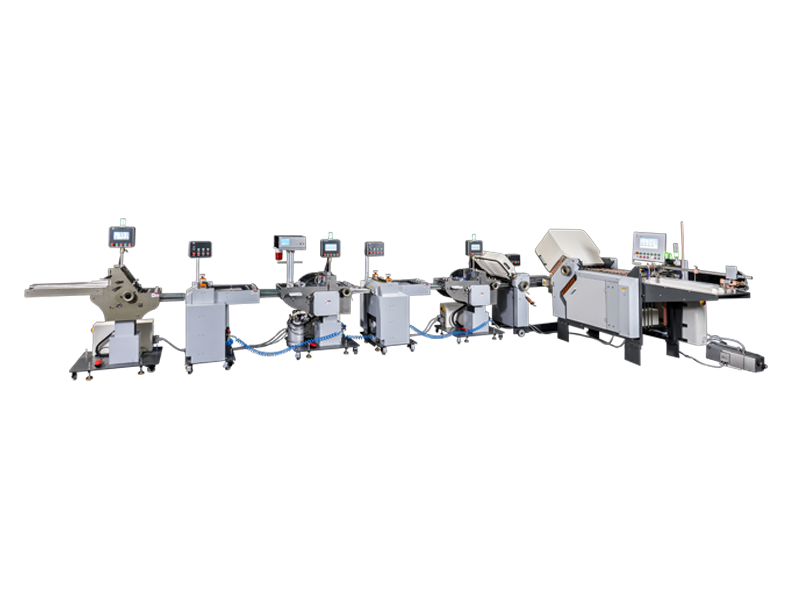
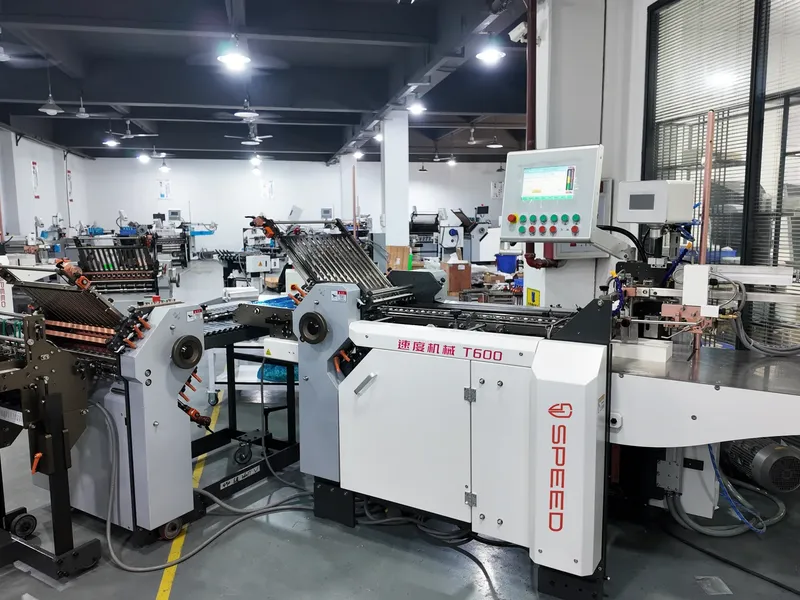
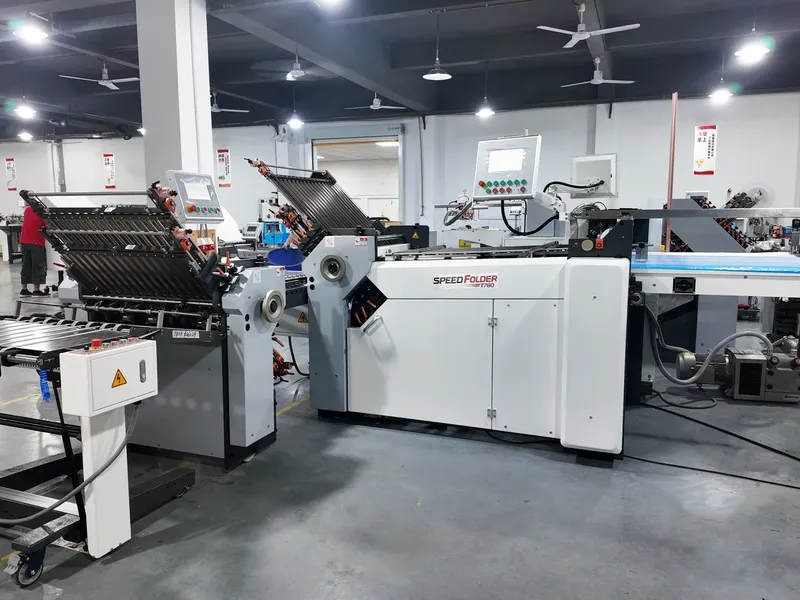
An automatic paper folding machine is a machine that automatically feeds, folds, and stacks printed sheets at high speed, without manual folding.
If you run a print shop, packaging factory, or pharmaceutical packaging line, you probably fold thousands of sheets every day — brochures, leaflets, instruction manuals, and drug inserts. Folding them by hand is slow, inconsistent, and expensive. An automatic paper folding machine solves that problem by turning a flat printed sheet into a finished, neatly folded product in seconds.
In this beginner's guide, you will learn what an automatic paper folding machine is, how it works, the three main types, what it can fold, and how to choose your first machine.
What Is an Automatic Paper Folding Machine?
Definition in Simple Terms
A paper folding machine is an industrial post-press machine used to fold paper sheets along straight lines under pressure, creating sharp, accurate creases.
An automatic version does the whole process by itself: it separates one sheet at a time from a stack, transports it through the folding unit, creates one or more folds, and delivers the finished product to a stacking table. The operator only needs to load paper, set the fold size, and monitor production.
Unlike a manual folder, which requires an operator to feed each sheet, an automatic paper folding machine can run continuously for hours, producing 20,000 to 60,000 folded sheets per hour depending on the model, paper size, and fold type.
Automatic vs Manual Folding
Manual Folding | Automatic Paper Folding Machine | |
|---|---|---|
Speed | 500 - 1,000 sheets/hour | 20,000 - 60,000 sheets/hour |
Accuracy | Depends on operator | ±0.5 - ±1.0 mm, repeatable |
Labor Cost | Very high | Low, 1 operator can run 1-2 machines |
Consistency | Varies from batch to batch | Stable across long runs |
Best For | Samples, very small batches | Commercial print, packaging, pharma |
For any job over 5,000 sheets, automatic folding is almost always faster and cheaper than manual folding.
How Does an Automatic Paper Folding Machine Work?
The working principle is simple to understand, even if the engineering inside is precise. The process has four continuous steps:
Step 1 - Feeding
Sheets are loaded onto the feed table. A vacuum suction head or friction roller separates the top sheet and feeds it into the machine one by one. Air blowers help separate thin or coated paper and prevent double-feeding.
Modern feeders also include double-sheet detection and automatic pile height adjustment, so the machine can keep running without constant adjustment.
Step 2 - Folding
The sheet enters a folding plate, also called a buckle plate. When the leading edge hits an adjustable stop, the paper buckles slightly. A pair of folding rollers catches that buckle and pulls it through, creating a sharp fold.
By arranging several folding plates in sequence, the machine can create two, three, four, or more parallel folds in a single pass.
Step 3 - Cross Folding (Optional)
For products that need a fold in a second direction — such as an 8-page or 16-page pharmaceutical insert — the sheet passes through a knife folding unit. A folding knife pushes the sheet down between a second set of rollers at a 90-degree angle, creating a cross fold.
This step is essential for multi-page inserts and book signatures.
Step 4 - Delivery and Stacking
After folding, the finished products are delivered by a slow-down belt to a stacking table. They are counted in batches, pressed flat, and stacked neatly for packing or for the next process, such as inserting into a carton.
Because feeding, folding, and delivery happen at the same time, the machine never has to stop between sheets.
3 Main Types of Automatic Paper Folding Machines
Not all automatic paper folding machines are the same. They are mainly classified by their folding method and feeding system. The three main types cover almost all commercial applications.
Type | Best For | Speed | Folding Accuracy |
|---|---|---|---|
Leaflets, brochures, pharma inserts | High | Very High | |
Combination Folding Machine | Books, signatures, large format | High | High |
Recirculating Feeder Folding Machine | Mass production, thin paper | Very High | Excellent |
1. Buckle Folding Machine
A buckle folding machine uses only buckle plates to create parallel folds. It is the most common and most flexible type.
It can produce almost all parallel fold types, including single fold, double parallel fold, letter fold, accordion fold, and gate fold. It is the first choice for pharmaceutical leaflets, promotional leaflets, brochures, and instruction manuals, especially when you handle many different jobs in small to medium batches.
If you are buying your first folding machine and you do not know which type to choose, a buckle folding machine is usually the safest option.
2. Combination Folding Machine
A combination folding machine, also called a buckle-knife combination folder, combines buckle folding units for parallel folds with knife folding units for cross folds.
It is designed for book signatures, large-format sheets, and long-run jobs. The knife unit is more efficient than a buckle unit for folding a large sheet in half, making this type ideal for book printing, catalogs, and magazines.
If your main business is book signature folding or large-format commercial print, a combination folding machine will give you higher efficiency and better stability.
3. Recirculating Feeder Folding Machine
A recirculating feeder paper folding machine uses a continuously circulating feeder to separate and deliver sheets without stopping.
Unlike a standard pile feeder, the recirculating design keeps the next sheet ready while the previous sheet is being folded. This reduces downtime, improves feeding stability for thin paper (40-70 gsm) and coated paper, and allows very high speeds for mass production.
It is widely used for pharmaceutical inserts, packaging inserts, and other long-run products where speed and feeding reliability are critical.
Automatic vs Semi-Automatic vs Manual: Which One Do You Need?
Type | Output / Hour | Labor Required | Best For |
|---|---|---|---|
Manual | < 1,000 | 1 operator, full-time | Samples, prototypes |
Semi-Automatic | 5,000 - 15,000 | 1 operator, frequent loading | Small print shops, short runs |
Automatic | 20,000 - 60,000 | 1 operator, can run 1-2 machines | Commercial printing, packaging, pharma |
A simple rule: if you spend more than three days per week folding by hand, or if a single job is over 10,000 sheets, an automatic paper folding machine will usually pay for itself in 6 to 12 months through saved labor and faster delivery.
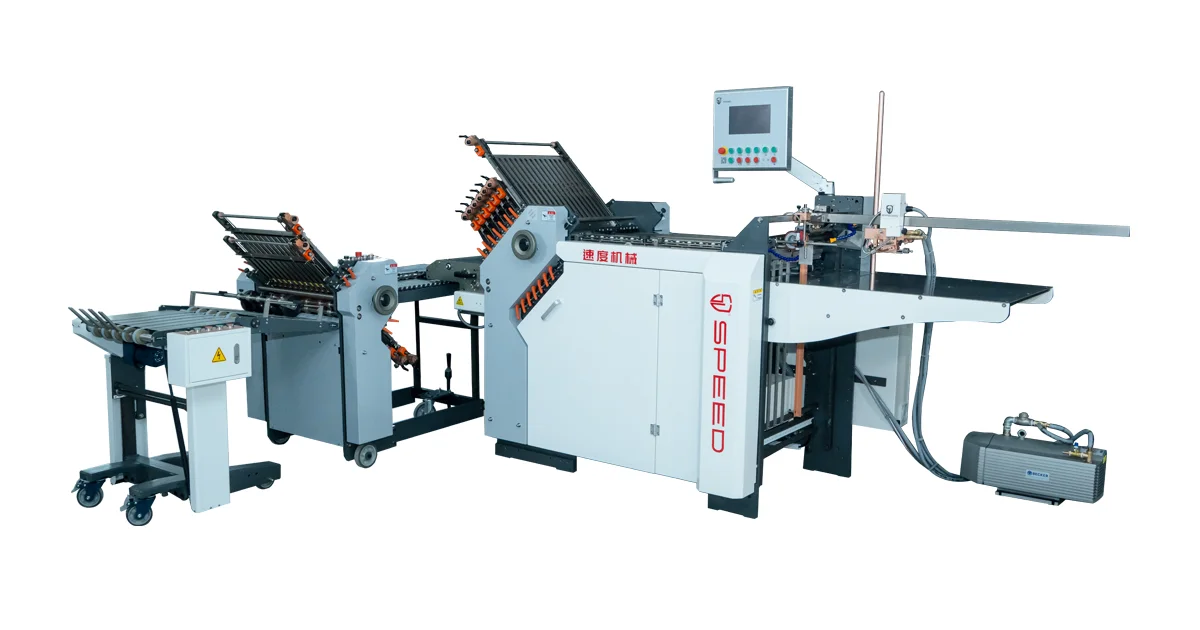
Core Components You Should Know
Understanding the main components will help you compare machines and talk to suppliers in technical terms.
Feeding Unit
The feeding unit separates and delivers sheets. Its performance determines whether the machine jams, double-feeds, or misfeeds. Look for adjustable suction, air separation, and double-sheet detection.
Folding Plates
Each folding plate controls one fold. The position of the stop determines the fold length. Motorized plates with digital display allow operators to recall saved jobs and change over in minutes instead of 20 minutes.
Folding Rollers
Hardened steel or polyurethane-coated rollers apply even pressure to create crisp creases. Roller diameter, hardness, and pressure adjustment affect fold quality, especially for coated and thick paper.
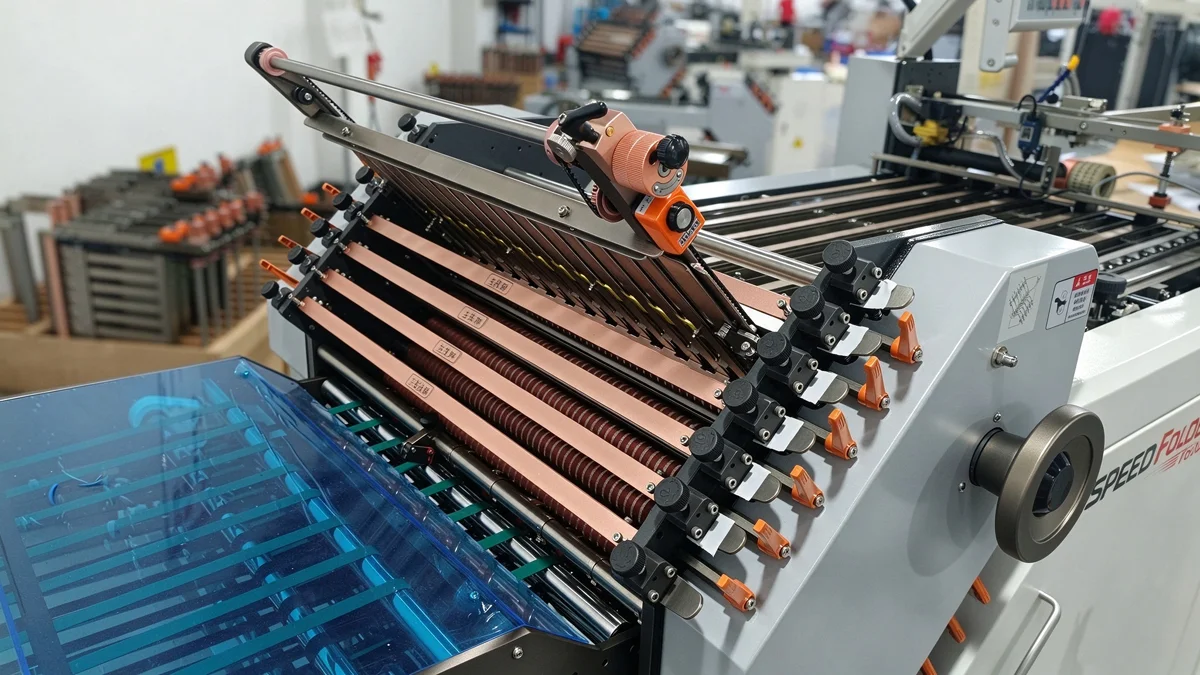
Knife Folding Unit
Used for cross folds. A precision knife and a pair of rollers fold the sheet at 90 degrees to the first fold. This unit is required for 8-page, 12-page, and 16-page products.
Delivery System
The delivery system includes a slow-down belt, pressing rollers, and a stacking table. Options include shingled delivery, batch counting, and automatic bundling, which improve downstream packing efficiency.
Control System (PLC + Touchscreen)
Modern machines use PLC control with a touchscreen HMI. Operators can store job recipes, monitor speed and output count, and receive alarms for jams or missing sheets. This reduces setup errors and training time for new operators.
What Can You Fold With It? Applications and Fold Types
Common Applications
An automatic paper folding machine is used across printing, packaging, and pharmaceutical industries:
- Instruction Manuals: User manuals, warranty cards, and safety instructions for electronics and home appliances
- Pharmaceutical Leaflets: Patient information leaflets and drug inserts, usually on thin 40-70 gsm paper
- Booklets and Catalogs: Product catalogs, book signatures, and promotional booklets
- Brochures and Flyers: Marketing brochures, flyers, and direct mail pieces
- Packaging Inserts: Leaflets and cards placed inside cartons and boxes for food, cosmetics, and consumer goods
- Books and Magazines: Folded signatures for binding
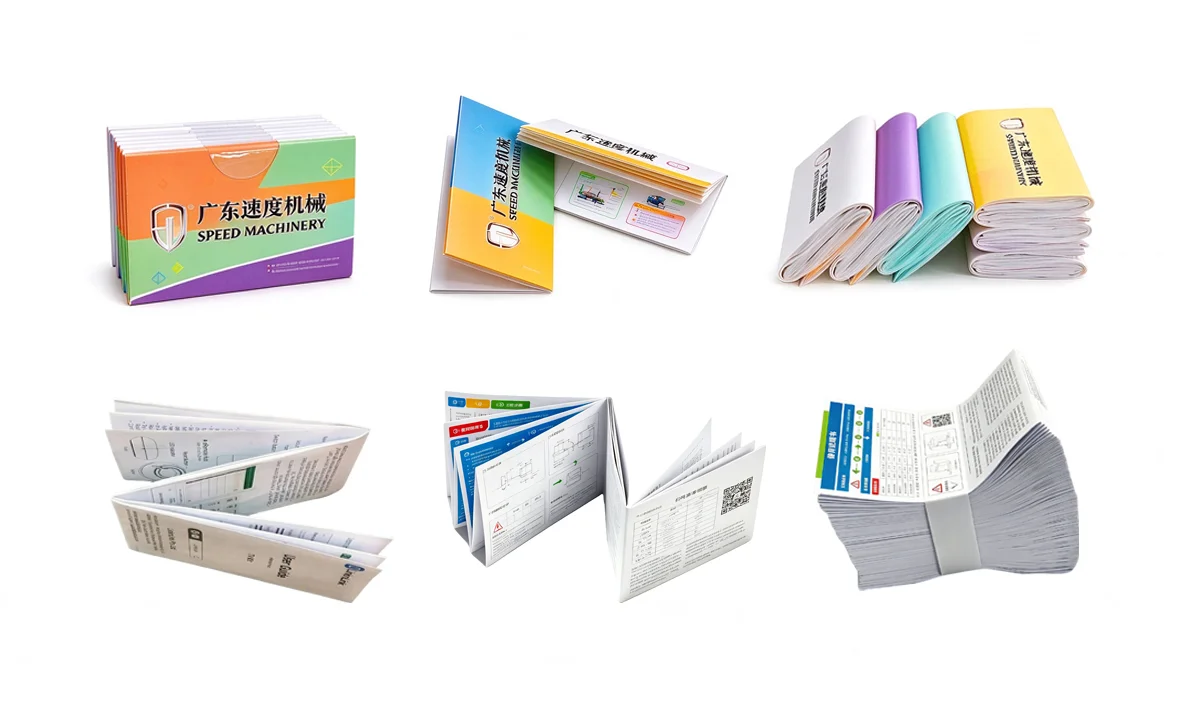
7 Popular Fold Types
One machine can produce many fold types by adjusting the folding plates and combining buckle and knife folding.
Fold Type | Description | Typical Use |
|---|---|---|
Single Fold | One fold in the middle | Simple leaflets, cards |
Tri-Fold / Letter Fold | Two folds forming a letter shape | Mailers, brochures |
Accordion Fold | Zigzag folds in opposite directions | Instruction sheets, maps |
Double Parallel Fold | Two folds in the same direction | 6-page brochures |
Roll Fold | Panels fold over each other in sequence | Multi-panel guides |
Gate Fold | Two side panels fold inward | Premium brochures, invitations |
Cross Fold | Fold in one direction, then at 90 degrees | 8-page, 16-page inserts |
When you evaluate a machine, list your top five fold types and confirm that the machine can produce them without extra tooling.
Key Specifications to Understand Before Buying
Speed is important, but it is not the only specification that matters. For a beginner, focus on these four parameters first.
Paper Size Range
This is the maximum and minimum sheet size the machine can handle, for example 720 x 520 mm maximum and 120 x 80 mm minimum. It determines what jobs you can accept. Always check this before you check speed.
Paper Weight Range
This is the range of paper thickness the machine can fold, usually expressed in gsm. A typical industrial model handles 40 to 250 gsm. Thin pharmaceutical paper needs gentle feeding, while heavy carton inserts need stronger folding force. A wider range gives you more flexibility.
Folding Speed
Rated speed is usually given in meters per minute (m/min) or sheets per hour under ideal conditions. Real production speed depends on paper size, paper weight, and fold complexity. For a realistic estimate, ask the supplier to test with your actual paper and fold pattern.
Folding Accuracy
High-quality machines maintain a folding tolerance of ±0.5 to ±1.0 mm. This is critical for pharmaceutical inserts and multi-panel folds, where even a 1 mm error is visible and can cause problems in automatic cartoning.
How to Choose Your First Automatic Paper Folding Machine?
You do not need to be an expert to choose the right machine. Answer these five questions first, and you will narrow down 90% of the options:
1. What is your main product?
What is the finished folded size and the unfolded size? How many pages?
2. What paper do you use most?
What is the weight, coating, and grain direction? Thin, coated paper is the most difficult to feed.
3. How much do you need to produce?
What is your daily and monthly volume? What is your peak-season demand?
4. Which fold types do you need?
List your top five fold types. This determines how many folding plates and knife units you need.
5. What is your budget and floor space?
Check machine dimensions, power supply (220V / 380V), and compressed air requirements.
Send these five answers to a supplier, and they can recommend a suitable model and give you an accurate quotation. Always ask for a sample folding test with your own paper before you buy.
Conclusion
An automatic paper folding machine is not just a faster way to fold paper. It is a way to improve accuracy, reduce labor costs, and deliver consistent quality for brochures, leaflets, instruction manuals, and pharmaceutical inserts at scale.
For a beginner, the key is not to buy the fastest machine, but to buy the machine that matches your products, your paper, and your real daily volume. Start with your fold types and paper specifications, then compare feeding systems, folding units, and changeover speed.
If you are looking for a buckle, combination, or recirculating feeder folding machine for your print shop, SPEED Machinery can help you test folding with your own paper samples. SPEED Machinery is a China-based manufacturer of high-speed automatic paper folding machines, with CE-certified products and ISO-certified management. Its team provides pre-sales selection consultation, sample folding tests, installation, training, and after-sales support.
Contact SPEED Machinery for a tailored recommendation and quotation — share your paper specifications, finished folded size, and target output, and they will suggest the most suitable model for your production.
Frequently asked
What is the difference between a paper folding machine and a paper folder?
They are essentially the same product. "Paper folder" is a shorter, more colloquial term commonly used in the US, while "paper folding machine" is the full industrial term used in B2B and international trade.
How fast is an automatic paper folding machine?
A high-speed automatic paper folding machine can run at 180-220 meters per minute, equivalent to 40,000-60,000 sheets per hour. Real production speed is lower for complex cross folds, large sheets, and heavy paper.
Can it fold coated paper?
Yes, but coated paper requires careful adjustment. Use lower roller pressure, clean the rollers frequently to prevent ink transfer, and ensure the feeder has strong vacuum separation and static control. A recirculating feeder is generally better for coated paper than a friction feeder.
What paper weight can it handle?
Most industrial models handle 40 to 250 gsm. Entry-level models typically cover 60-180 gsm, while high-speed mass-production models cover 40-250 gsm, including thin pharmaceutical paper and heavier carton inserts.
Is an automatic paper folding machine worth it for a small print shop?
Yes, if you fold more than three days per week or if a single job is over 10,000 sheets. The labor savings and faster turnaround usually justify the investment within 6 to 12 months. For very small batches under 1,000 sheets, a semi-automatic model may be more cost-effective.